


Leadership Resilience: Turning the Tide To Come Back Stronger
The promotion went to someone else.
The quarter missed targets.
Your best team member just resigned.
In those gut-punch moments, what separates leaders who spiral from those who come back stronger?
Leadership resilience isn't about avoiding setbacks—it's about mastering the art of the comeback. This is the reality we want to focus on in this article.
Meet Charlotte Henshaw: Champion of the Comeback
Charlotte Henshaw, two-time Paralympic medalist and world champion, has turned disappointment into her secret weapon through a systematic approach she calls "Turning the Tide."
From missing Olympic medals to completely switching sports mid-career, Charlotte has faced setbacks that would end most people's dreams. Instead, she developed this battle-tested 6-step framework that transforms how leaders respond when things don't go to plan. And the best part? You can start applying it today.
Charlotte isn't just talking about resilience from theory—she's lived it at the highest level. As a two-time Paralympic medalist (gold in Tokyo 2020, bronze in Rio 2016) and world champion in paracanoeing, she's navigated career-defining disappointments that would break most athletes.
Her journey includes missing out on medals at the London 2012 Paralympics in swimming, then making the bold decision to switch to an entirely new sport—paracanoeing—where she had to start from scratch. That pivot led to her standing on Olympic podiums, but only after mastering the art of bouncing back from crushing setbacks.
The framework she developed through this journey—Turning the Tide—isn't about positive thinking or motivation posters. It's a systematic process for turning disappointment into momentum, one step at a time.
The same principles that help elite athletes recover from Olympic disappointments apply directly to boardroom setbacks—lost deals, failed initiatives, and team turnover. Charlotte's "Turning the Tide" framework isn't theory—it's a battle-tested system for transforming disappointment into momentum.
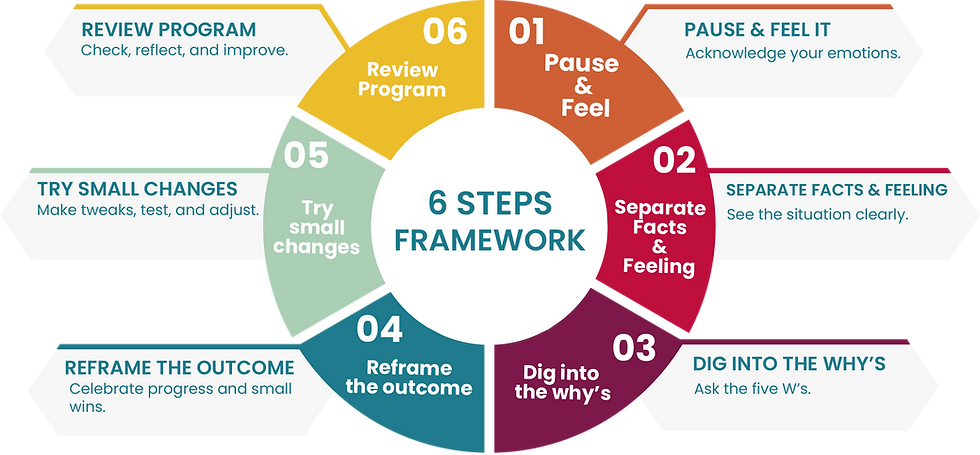
Charlotte Henshaw's Turning the Tide Framework
In Charlotte's words:
We all face moments that don’t go to plan. What defines us isn’t the setback itself, but how we respond to it. Turning the Tide is a six-step framework inspired by my journey as an athlete and leader - a simple guide which always helps me turn challenges into momentum and one which I hope can help you lead with resilience.
Leadership Resilience Step 1: Pause and Feel It
When things don’t go to plan, it’s natural to want to move on quickly - but slowing down is often the most powerful first step. Allow yourself to acknowledge what’s happened and how it made you feel. Take time to sit with those emotions rather than burying them. Talk it out, write it down or simply give yourself permission to feel disappointed. That space is what helps you reset with honesty and clarity.
💡 Personal tip: The best way I've found to process any emotions after a setback is to be out in nature. A short walk, a drive into the countryside or even just a coffee outside can provide me with the headspace needed to let my emotions settle.
Step 2: Separate Fact from Feeling
Once the emotions have settled, then comes the time to make sense of the situation. One of the best ways to do that is by distinguishing between what’s true and what’s emotional. Write down what actually happened - the facts - and then list how it made you feel. This simple exercise can help cut through the noise and will bring perspective. Often, once you see things clearly on paper, the next step forward becomes obvious.
💡 Personal tip: I'm a list maker - in every aspect of my life. And it is no different here. I like to list facts and emotions on the same page so I can easily identify what I'm feeling and separate it from fact.
Step 3: Dig Into Why
Growth starts with curiosity. When something doesn’t go as planned, ask yourself why - and don’t stop at the first answer. Look at your routines, mindset, communication, and preparation. The aim isn’t to assign blame, but to understand what really happened.
💡 Personal Tip: Using the “five Ws” - what, why, when, where, and who - has always helped me to uncover the patterns behind the outcome and spot opportunities for change.
Step 4: Reframe the Outcome
A result on paper rarely tells the full story. Sometimes success looks different than you first imagined. Sometimes just showing up, finishing strongly or simply maintaining effort through difficult moments can all be wins in their own right. By shifting your focus to what did go well, you start to see progress even in tough moments. This change in perspective can reignite motivation and remind you how far you’ve already come.
💡 Personal tip: Being kind to myself in difficult moments hasn’t always come naturally. I used to see things as either total success or total failure. Learning to break out of that all-or-nothing mindset has been one of the most valuable tools in my recovery process after disappointment.
Step 5: Try Small Changes
After a disappointment, it’s tempting to overhaul everything - but often, real progress comes from small, intentional tweaks. Adjust one thing at a time and pay attention to the results. Test it, learn from it and keep building. Incremental changes compound over time into big transformations.
💡 Personal tip: For me, a new warm-up routine, a mindset shift or a small change in how I use self-talk before competing have all been simple but effective adjustments. Each was small enough to implement easily, yet measurable enough to assess whether it made a difference.
Step 6: Review Your Progress
Improvement doesn’t end with making a change - it’s about staying curious and reflective. Set aside regular check-ins to evaluate what’s working and what still needs adjustment. Whether it’s with a valued colleague or a trusted friend, honest conversations keep you accountable and aligned. Think of it as a loop rather than a finish line: reflect, refine, and repeat. That’s how progress becomes sustainable.
💡 Personal tip: Every six weeks, my closest support team and I hold structured check-ins - alongside weekly meetings with my coach. These two touch-points give us space to assess what’s working, celebrate progress and stay aligned on our goals.
Charlotte's framework works because it's built on real consequences, not theory. But here's what she'd tell you from experience: resilience isn't just an individual skill—it's a team capability. The organizations that bounce back fastest from market shifts, leadership transitions, or failed initiatives are those where resilience is embedded in their culture.
Building Team Resilience That Drives Results
Charlotte's Turning the Tide framework proves that leadership resilience isn't something you're born with—it's a skill you can develop, refine, and scale across your entire organization.
At Petadiri, we help Malaysian organizations build this capability through executive coaching programs and leadership development pathways designed for C-suite leaders, senior managers, and emerging talent. Our clients report stronger team engagement, faster recovery from setbacks, and leaders who inspire performance even under pressure.
Whether you're sharpening your own bounce-back ability or building resilience across your leadership team, we create customized solutions that deliver measurable results.
Ready to turn setbacks into your competitive advantage? Let's build your resilience roadmap.
Start your leadership development journey today and watch your organization thrive!


